A little bit off topic of practical school tech, but seeing that if you're here you can probably appreciate the technical nature of this post.
Ever try walking a friend through a router setup remotely? Usually if you're doing this they don't have working internet so screen sharing is out. Find yourself saying often, "Do you see something that says status?" Or my favorite, "What does it say on the screen now?" Usually while I'm saying these things I've got Google image search pulled up looking for a "linksys e6900 configuration screen" (or whatever model they have) and hoping that someone has uploaded a picture of it. A picture is worth a thousand words, right? Even a simple shot of the E6900 configuration page like this one can save an hour of trying to describe over the phone what button they are looking for.
If that pictures worth a thousand words, how much would an accessible interface be worth?
I think I'm a little late to the party but I found an awesome site the other day that is even better than a picture. Full, interactive copies of the user interface of multiple models including multiple firmware versions.
http://ui.linksys.com/
It's by Linksys so it's only their routers. Take what you can get right? It's even fairly up to date. I couldn't find one of their latest models, but did see files from October or November of 2013.
Problems and the occasional solution for technology issues encountered in a the K-12 education environment.
Tuesday, February 11, 2014
Friday, February 7, 2014
Another day another Chromebox, or two.
HP announced today that they are going to be offering a Chromebox as well. Here's their page if you're interested, http://h20435.www2.hp.com/t5/The-Next-Bench-Blog/HP-Chromebox-Chrome-simplicity-tiny-desktop/ba-p/87295.
Google announced their Chromebox for Meetings, too. Technically it's not a new Chromebox, it's just a bundle that combines the new ASUS Chromebox, a camera, a speaker, a mic, and a remote. Here's some of the details from Google on this one, http://googleblog.blogspot.com/2014/02/chromebox-now-for-simpler-and-better.html.
That's pretty amazing isn't it? It seemed like the manufacturers were just going to let the Chromeboxes wither and die for so long and now they're popping up all over the place. Check out the Chromebase that LG announced back in December, http://lgnewsroom.com/newsroom/contents/64056. This one isn't really a Chromebox, but it's definitely not a Chromebook either.
Why is this even relevant to practical school tech? ChromeOS devices are pretty easy to manage, fairly stable, designed to be reliable (mostly fanless and all solid state), and can be priced pretty cheap. All important things for the education market. Now let's see if we can get our hands on some so we can go kick the tires and see if they live up to all this hype.
Google announced their Chromebox for Meetings, too. Technically it's not a new Chromebox, it's just a bundle that combines the new ASUS Chromebox, a camera, a speaker, a mic, and a remote. Here's some of the details from Google on this one, http://googleblog.blogspot.com/2014/02/chromebox-now-for-simpler-and-better.html.
That's pretty amazing isn't it? It seemed like the manufacturers were just going to let the Chromeboxes wither and die for so long and now they're popping up all over the place. Check out the Chromebase that LG announced back in December, http://lgnewsroom.com/newsroom/contents/64056. This one isn't really a Chromebox, but it's definitely not a Chromebook either.
Why is this even relevant to practical school tech? ChromeOS devices are pretty easy to manage, fairly stable, designed to be reliable (mostly fanless and all solid state), and can be priced pretty cheap. All important things for the education market. Now let's see if we can get our hands on some so we can go kick the tires and see if they live up to all this hype.
Wednesday, February 5, 2014
An affordable Chromebox.... Finally
I really like the idea of ChromeOS devices for school use. Think about it, automatic updating, very narrow attack vector, fast boot, plain and simple operation. What's not to like about it? Ok ok I understand, everything has to be web-based. But is that so bad? Really, how often is your connection to the internet down? I know lots of people talk about how good the cloud is and a lot of people preach about how bad the cloud is. Wait a minute, I'm getting side tracked, I'll save this topic for another post, let's move on to what I was wanting to talk about.
Chromeboxes. More importantly, affordable Chromeboxes. Asus has announced a new Chromebox starting at $179 (really, read about it here http://www.asus.com/us/News/xjbJtLA1HEyUSUeo). That's pretty cheap, right? But you might be saying the Samsung Chromeboxes for $300 or $500 were affordable too. Yes, they were affordable, until you consider that you can buy a refurbished computer for $500 (with a monitor.) That's a full PC too, it runs Windows and everything. Chrome versus Windows is going to be another post.
Back to the affordable Chromeboxes, in education every dollar counts, $179 is much more affordable than $300. That's a lot more computers being made available for the students. I'll call that a win.
Now for my rant.
Chromeboxes have been out for some time. Just a small computer that runs ChromeOS, nothing particularly special. The prices have been ridiculously high though. Before today's announcement they were around $300 dollars. That doesn't sound too bad for a computer. But, Samsung has a whole Chromebook for $249. Some might point out that that's obviously different because it's an ARM processor and the Chromeboxes all have Intel processors. I could care less about that. I need a computer that runs, the ARM based Chromebooks do that just fine. Why not strip out the portable bits of a Chromebook and squeeze them into a super small package? How much could you save if you cut off the screen, battery, keyboard and trackpad?
Chromeboxes. More importantly, affordable Chromeboxes. Asus has announced a new Chromebox starting at $179 (really, read about it here http://www.asus.com/us/News/xjbJtLA1HEyUSUeo). That's pretty cheap, right? But you might be saying the Samsung Chromeboxes for $300 or $500 were affordable too. Yes, they were affordable, until you consider that you can buy a refurbished computer for $500 (with a monitor.) That's a full PC too, it runs Windows and everything. Chrome versus Windows is going to be another post.
Back to the affordable Chromeboxes, in education every dollar counts, $179 is much more affordable than $300. That's a lot more computers being made available for the students. I'll call that a win.
Now for my rant.
Chromeboxes have been out for some time. Just a small computer that runs ChromeOS, nothing particularly special. The prices have been ridiculously high though. Before today's announcement they were around $300 dollars. That doesn't sound too bad for a computer. But, Samsung has a whole Chromebook for $249. Some might point out that that's obviously different because it's an ARM processor and the Chromeboxes all have Intel processors. I could care less about that. I need a computer that runs, the ARM based Chromebooks do that just fine. Why not strip out the portable bits of a Chromebook and squeeze them into a super small package? How much could you save if you cut off the screen, battery, keyboard and trackpad?
Monday, January 20, 2014
Fixing Bootable USB disks in Windows 7
A couple of months back in my post on installing Cacti I mentioned that I first ran into trouble copying the image to a flash drive. At the time I quickly moved on to another flash drive and continued to install Ubuntu. The problem flash drive got dropped back in the box with other flash drives to be fixed another day. Well, that day came. I needed to install a fresh copy of Windows 7, I grabbed the flash drive, started up the Window 7 USB DVD Download Tool and proceeded to copy the image to the flash drive. Not so fast, I ran into problems copy Windows just like I did copy Linux. Luckily, this time I wasn't under such a time crunch so I had a minute to fix the problem rather than just grabbing another drive.
A quick Google of the "Unable to copy files" error message turned up Julio Franco's post over a TechSpot. His instructions were spot on. I just have this bit of insight to add. He mentions at the end that you need to be careful in selecting disks. Yes, you definitely need to be careful in selecting disks or you'll be in serious trouble when you get finished.
A quick way to make sure you get the right disk. Unplug your flash drive, do the "list disk" command, then plug your flash drive back in, and do the "list disk" command again. You should notice an extra disk show up between the first time you typed the command and the second time. That disk is your flash drive.
A quick Google of the "Unable to copy files" error message turned up Julio Franco's post over a TechSpot. His instructions were spot on. I just have this bit of insight to add. He mentions at the end that you need to be careful in selecting disks. Yes, you definitely need to be careful in selecting disks or you'll be in serious trouble when you get finished.
A quick way to make sure you get the right disk. Unplug your flash drive, do the "list disk" command, then plug your flash drive back in, and do the "list disk" command again. You should notice an extra disk show up between the first time you typed the command and the second time. That disk is your flash drive.
Friday, January 10, 2014
Server 2012 Activation Error 0x8007007B
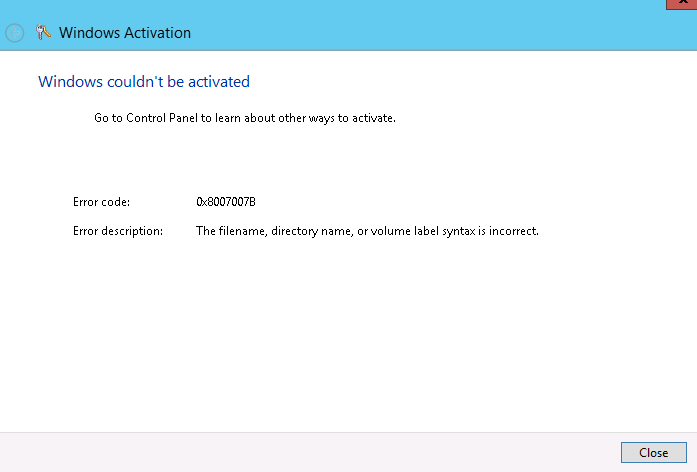
I recently noticed that I had one server that refused to activate. There were several of these begging for activation before I got Key Management Server (KMS) up and running and I thought they had all activated. Apparently, I overlooked one. I logged into a rarely used box and there it was, requesting activation. Ok, simple enough, I didn't know why it hadn't activated on it's on, but that was ok, I'd click the box to activate it. Not so fast, I clicked the box, waited for it to finish and then I got hit with a "0x8007007B Windows couldn't be activated" error message like this one.
How friendly, at least it had an error code. So I started my search of what causes this error. I investigated some of the causes others had posted and didn't have any luck. Then I found this Microsoft knowledge base article. Method #3 is what pointed me in the right direction. I tried the mention command
nslookup -type=all _vlmcs._tcp>kms.txt
and got this "Non-existent domain" error message.
I don't think that's supposed to happen. I try this command on another server and it generates a nice pretty txt file similar to what's shown in the kb article. This means we've uncovered another sympton. Time to do some more digging and to figure out what can cause this error.
It turns out what was happening is that the DNS suffix (the part after the host name) wasn't getting added correctly to DNS queries. What this means is when it tries to lookup these records that it is failing because it doesn't know the domain name, hence the "Non-existent domain".
Here's an article that I found about DNS suffixes. It mentions this handy powershell command to check your settings.
Get-DnsClientGlobalSettingHere's what my settings looked like.
This might be part of my problem. Off to the network adapter configuration we go. I check the DNS settings and the DNS suffix for the connection appears to be correct. For whatever reason the server is just refusing to use it. Luckily, there's a handy "Append these DNS suffixes" section right above that. I added the correct DNS suffix right there. It now looks similar to this screen.
After click OK half a dozen times I was ready to try to activate Windows again. Success.... It worked that time.
Friday, December 13, 2013
DFS Replication and the SYSVOL Problems
I recently noticed on one of my domain controllers that there were some warnings in the Event Log for DFS Replication. Well, actually what I noticed was that the SYSVOL folder on some of my DCs didn't have all of the GPO folders. A bit of searching to find out what causes that led me to looking into the Distributed File Services Replications. Which in turn led me to the event viewer. Which led me to the Warning ID 2213 from DFSR.
Yay! I love warnings in the event viewer. Wait, this is just a warning, "Hey, by the way I'm not replicating your crap any more and I'm not going to replicate it any more until you manually intervene." Isn't that nice? This looks like something that should be more than just a "warning."
The warning looks a bit scary, but it is very helpful in that it tells you exactly how to fix it. Have to give Microsoft points for that one, put the fix right there in the warning. I mean, you can copy and paste the command out of the warning message and into a command prompt and it'll fix itself.
Now, why exactly did I have to wade through the event viewer to find this warning and this command? Where's Clippy when you need him? A nice "Hey I noticed you didn't do a clean shutdown, would you like to re-enable your SYSVOL replication, it might be important?" Why did they neglect that? When I log back in it asks me why it was shut down improperly, why not take that same opportunity to ask about re-enabling the replication too?
But, I digress, back to fixing replication. What you ask? I'm not done yet? I told you to cut and paste the command from the event description to fix it didn't I?
If you're like me, it didn't work. I selected the text, I copied the text, I click on the Powershell prompt, waited it for it to open, I pasted the command and finally pressed enter. Only to be greeted with an "Unexpected switch at this level" message. Well that was nice and friendly. I bet I need an elevated prompt. So this time I right-clicked on the Powershell prompt and selected "Run as Administrator." Surely that will fix it, nope, it doesn't, it gives you the same error message. Ok, so I must have just not selected everything before I copied. I tried it a few more times, nothing, same error message.
Now it's time to hit the internet. I do some searching and I find this post over on howdoicomputer.com. It looks like they ran into the same problem. The trick is to use a regular command prompt, not a Powershell prompt. How do you like that? The answer's right in the event message, "from an elevated command prompt." So Microsoft's be all end all Powershell prompt is useless when it comes to using this WMI command.
I also ran into the DFSR error 4012 that they mention in that same post over at howdoicomputer.com.
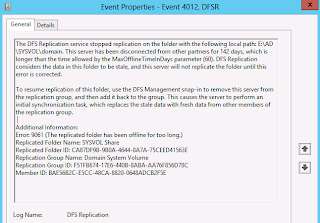
By default, you've only got 60 days to correct the problem, after that it will not restart replication. The quick fix for that is to change that default window to something greater than however many days you have been out of replication and then run the command again. The command for increasing that default is:
wmic.exe /namespace:\\root\microsoftdfs path DfsrMachineConfig set MaxOfflineTimeInDays=200
That 200 on the end is the number of days to increase it to (you can pick anything above how many days you're out).. I'm a bit embarrassed to admit, that I had run substantially longer than the 60 day default (you can see in the screenshot) and had to increase it a lot to get it to run. However, when I finished I did set it back its default of 60 days.
When it's all said and done you should get a Information event from ID 2214 that says the replication service successfully recovered.
![]() |
| The warning |
Yay! I love warnings in the event viewer. Wait, this is just a warning, "Hey, by the way I'm not replicating your crap any more and I'm not going to replicate it any more until you manually intervene." Isn't that nice? This looks like something that should be more than just a "warning."
The warning looks a bit scary, but it is very helpful in that it tells you exactly how to fix it. Have to give Microsoft points for that one, put the fix right there in the warning. I mean, you can copy and paste the command out of the warning message and into a command prompt and it'll fix itself.
Now, why exactly did I have to wade through the event viewer to find this warning and this command? Where's Clippy when you need him? A nice "Hey I noticed you didn't do a clean shutdown, would you like to re-enable your SYSVOL replication, it might be important?" Why did they neglect that? When I log back in it asks me why it was shut down improperly, why not take that same opportunity to ask about re-enabling the replication too?
But, I digress, back to fixing replication. What you ask? I'm not done yet? I told you to cut and paste the command from the event description to fix it didn't I?
If you're like me, it didn't work. I selected the text, I copied the text, I click on the Powershell prompt, waited it for it to open, I pasted the command and finally pressed enter. Only to be greeted with an "Unexpected switch at this level" message. Well that was nice and friendly. I bet I need an elevated prompt. So this time I right-clicked on the Powershell prompt and selected "Run as Administrator." Surely that will fix it, nope, it doesn't, it gives you the same error message. Ok, so I must have just not selected everything before I copied. I tried it a few more times, nothing, same error message.
Now it's time to hit the internet. I do some searching and I find this post over on howdoicomputer.com. It looks like they ran into the same problem. The trick is to use a regular command prompt, not a Powershell prompt. How do you like that? The answer's right in the event message, "from an elevated command prompt." So Microsoft's be all end all Powershell prompt is useless when it comes to using this WMI command.
I also ran into the DFSR error 4012 that they mention in that same post over at howdoicomputer.com.
![]() |
| The error |
By default, you've only got 60 days to correct the problem, after that it will not restart replication. The quick fix for that is to change that default window to something greater than however many days you have been out of replication and then run the command again. The command for increasing that default is:
wmic.exe /namespace:\\root\microsoftdfs path DfsrMachineConfig set MaxOfflineTimeInDays=200
That 200 on the end is the number of days to increase it to (you can pick anything above how many days you're out).. I'm a bit embarrassed to admit, that I had run substantially longer than the 60 day default (you can see in the screenshot) and had to increase it a lot to get it to run. However, when I finished I did set it back its default of 60 days.
When it's all said and done you should get a Information event from ID 2214 that says the replication service successfully recovered.
![]() |
| It's fixed! |
Friday, December 6, 2013
Troubleshooting Google Chromebook Policies
Using Google Apps to manage policies Chromebook Policies? Want to know what settings are applied to a device (or user) and when they were last updated? Then I have found your new best friend, chrome://policy/, just load it up and take a look at what policies are getting applied.
The key pieces of information that I used were the "Last fetched" and "Applies to".
Another handy item listed there is the "Reload policies" button. It comes in real handy for testing how changes affect the operation of the system.
Now I just have to go check out what this looks like on a Windows system running Chrome.
![]() |
| chome://policy |
The key pieces of information that I used were the "Last fetched" and "Applies to".
Another handy item listed there is the "Reload policies" button. It comes in real handy for testing how changes affect the operation of the system.
Now I just have to go check out what this looks like on a Windows system running Chrome.
Labels:
chrome,
chromebook,
google,
google apps,
policy,
reload policies
Subscribe to:
Posts (Atom)